
Over 99.9% of what is emitted from the stack consists of normal components of air, including nitrogen, oxygen, and water vapor. Approximately 12.5% of that is carbon dioxide (CO2), 10% oxygen, and 68% nitrogen.
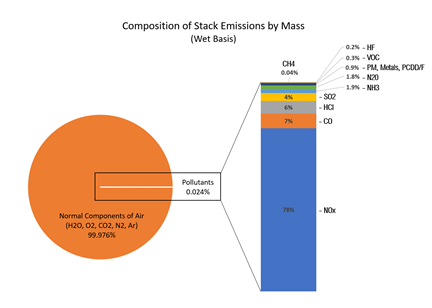
The remaining 0.024% of what is emitted from the stack includes nitrogen oxides (NOx), sulfur dioxide (SO2), carbon monoxide (CO), particulate matter (PM), and volatile organic compounds (VOCs) among several other substances considered pollutants. For these and other constituents, Reworld™ Camden performs much better than federal and regional standards. To learn more about our environmental performance, as well as emissions from other sources within Camden County, check out the full Facility Fact Sheet here.
- the amount of waste processed,
- the emissions that are allowed, and
- how the air pollution control system is operated.
Research has produced study after study indicating modern thermomechanical treatment facilities employing a Waste-to-Energy process do not pose a significant health risk of any kind for those living in direct proximity. To minimize any environmental impact, Reworld™ operates the Camden facility up to 95% below its federally regulated standards for emissions. We transparently report on the facility’s emissions performance as part of our corporate sustainability reporting.
While further improvements in overall air quality need to be the goal, particularly in communities that have historically borne a disproportionate burden, it is important to note that air quality has been significantly improving in Camden, not getting worse. Overall, according to EPA data found using this tool, concentrations of major pollutants often linked to various health issues have been continuously reduced over time in Camden County. In 2022, concentrations of nitrogen dioxide (NO2), one of the major compounds included under ‘NOx emissions’, were actually below the state average in Camden County.
Concentrations of regulated criteria air pollutants including nitrogen oxides (NOx), sulfur dioxide (SO2), fine particulate matter (PM2.5), and ozone (O3) have been reduced up to 97% in Camden County over the last 20 years. Notably, the Reworld™ facility in Camden is actually a relatively small source of these and other pollutants, representing 3% of total NOx emissions within the county as of 2022. See below for more on how our emissions compare to other sources in the county.
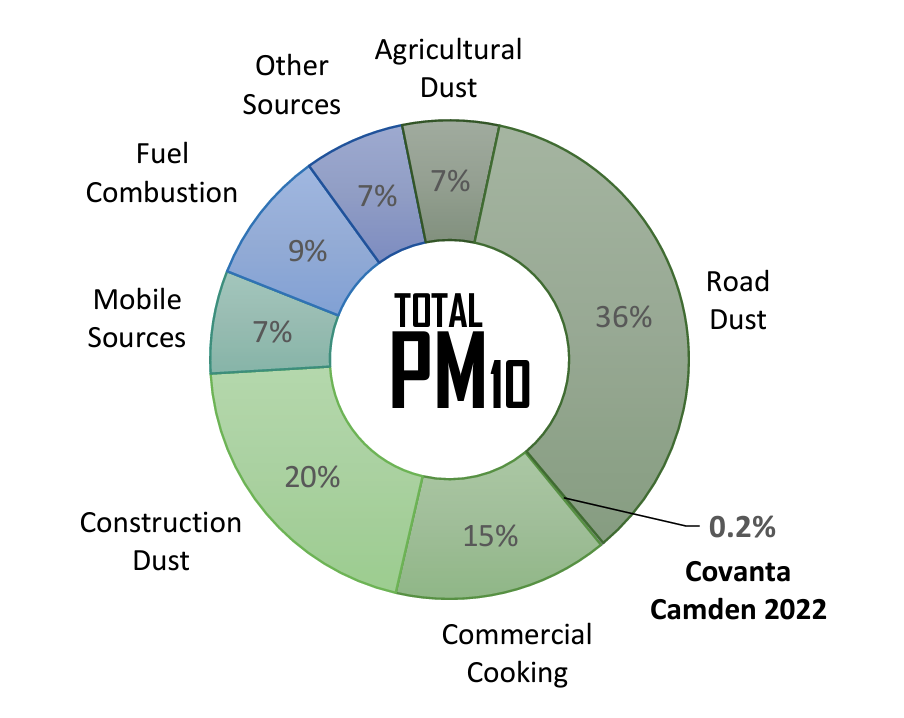
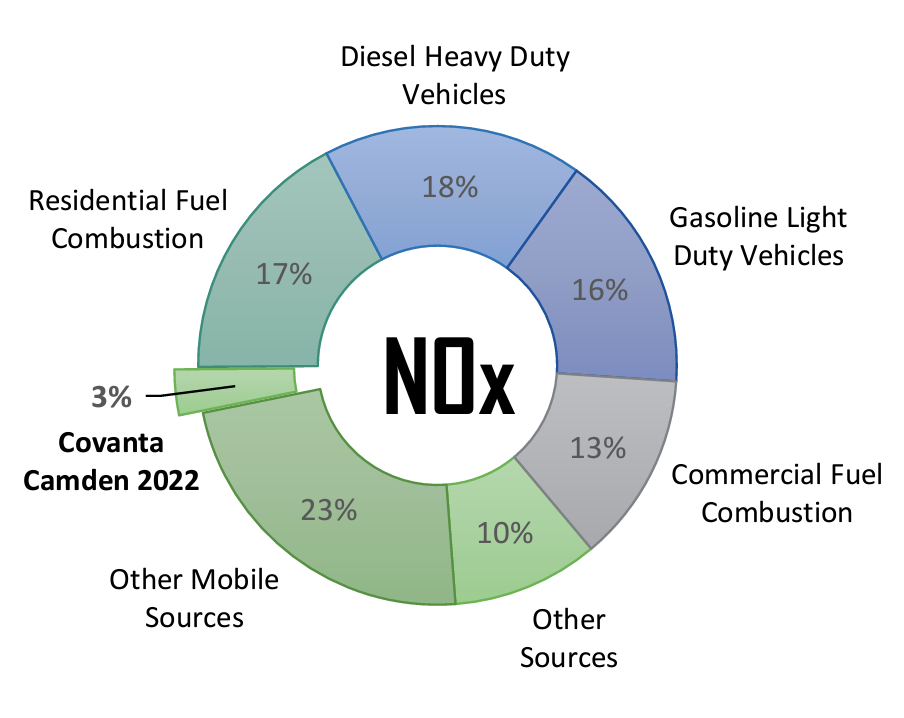
Facilities like Reworld™ Camden have drawn criticism focusing on a few specific pollutants, namely dioxins and mercury. For dioxins, the facility performs 95% better than permitted levels (or in other words, 95% below permitted levels). According to peer-reviewed scientific research, all of the waste-to-energy facilities in the United States represent less than a tenth of one percent of total sources of dioxin. Dioxin emissions in the U.S. today are predominately from uncontrolled combustion, with fires at landfills representing the largest sources.
According to a recently published study WTE facilities are a minor source of mercury in the U.S. as well, representing just 0.8% of man‐made sources, roughly half that emitted from landfills. U.S. and global scales of comparison are relevant to mercury, as mercury is a global pollutant that can travel thousands of miles before it is deposited and from there potentially enter the food chain. Globally, waste combustion represents just 0.7% of total human-caused mercury emissions.
According to both the United States Environmental Protection Agency (EPA) and the European Commission, the most sustainable option for waste management is to prevent waste from being generated, followed by reuse, recycling, and then energy recovery via waste-to-energy at thermomechanical treatment facilities (TTFs). As a result, some of the most sustainable countries in the world rely heavily on TTFs to process their waste. However, most of the waste generated in the US is still disposed of in landfills, even though no state or other jurisdiction defines landfilling as preferred to waste-to-energy through any policy, regulation, or law.
Landfills are unsustainable for several reasons, the most prominent being greenhouse gas emissions. Landfills emit methane, which is a powerful greenhouse gas that directly contributes to climate change. Eliminating one ton of methane emissions is equivalent to eliminating about 84 tons of carbon dioxide emissions. By diverting waste from landfills, thermomechanical treatment significantly reduces methane emissions. Learn more about the benefits of TTFs here.
Reworld™ fully supports policies to enact better waste reduction, reuse and recycling throughout Camden County. Our thermomechanical facilities are fully compatible with, and in fact complementary to, improved recycling. Many of our communities have a higher recycling rate than the national average — with some reaching over 50%. A growing part of our work is recovering more metals, both ferrous and non-ferrous, from the ash left over following combustion. Currently, Reworld™ Camden already recycles enough metal every year to build nearly 11,000 cars.
Besides contributing to improved environmental security for future generations, the facility creates over 50 full-time jobs, 13 of which are held by local residents living within 5 miles of the facility. We also continuously provide economic stimulus to Camden through procurement of goods and services.
The facility in Camden also contributes meaningfully via involvement with several local organizations and institutions. In 2017 Reworld™ Camden was recognized by the Camden Collaborative Initiative for our joint effort with the Go Green Initiative to bring recycling to Camden City Schools. This is just one example of our work to provide social and economic benefit to the community, in addition to inherent environmental benefits provided by our operations. We also provide a significant source of revenue to the City that helps ensure the continuation of essential services. To read more of our work in the community and to see some of the organizations we work with in Camden, check out our Community Blog here.
Since acquiring the Camden facility in 2013, we have invested over $55 million in maintenance and capital expenditures to improve operations and the environmental performance of the facility. A Selective Non-Catalytic Reduction (SNCR) system was also installed at the Camden facility to reduce emissions of nitrous oxides.
Reworld™ committed to the implementation of five projects across our fleet to further reduce emissions specifically in environmental justice communities. Installing a baghouse at the Camden facility is one of these five projects as part of the Camden Green Initiative. To learn more about this innovative project that will bring great benefits to the city, click here.
The Reworld™ Camden facility was sited by local government and previous owners decades ago. Facilities like this one were sited due to proximity to industrial centers, which typically translate to large waste generation points, accessibility for waste haulers, availability of water sources for operations, and proximity to a technical workforce.
These facts do not necessarily make the locations of these facilities just, which is why through partnerships with local leaders, Reworld™ established the Community Outreach and Environmental Justice Policy in 2011. The policy was ground-breaking in its efforts to create a pact with our neighbors in every community where we operate, that we recognize our duty and accountability to perform our operations safely and responsibly. The policy documented our acknowledgement that as a corporate citizen, we have a responsibility to the individuals who live alongside us, to address their concerns and create a dialogue of ongoing understanding and transparency.
Through this environmental justice policy, we have not only formally established our position on the importance of local communities in making decisions that impact their environment but are also thereby committed to reducing emissions from Reworld™ Camden. In recent times, we have been vehement supporters of the new environmental justice law in New Jersey and pushed for Camden’s microgrid project to build the community’s resiliency in preparation for future natural disasters. That commitment also requires transparency about our operations, which is why we have worked to make our continuous emissions monitoring data for the Camden facility available for anyone to view 24 hours a day, seven days a week at www.reworldwaste.com/camden. This data is the same information monitored by the New Jersey Department of Environmental Protection (DEP) and required by the facility’s air permit to ensure its adherence to the state’s stringent environmental regulations. It is also used by operators onsite at the facility to track emissions, anticipate potential issues and resolve them to ensure compliance.