

Facilities
Camden
Reducing Landfill Waste
Located in Camden, New Jersey, the Reworld Camden Energy Recovery Center is an award-winning Thermomechanical Treatment Facility that serves the 32 municipalities in Camden County and the surrounding region with reliable and sustainable waste management. Every year, our facility processes more than 390,000 tons of waste that would otherwise have ended up in landfills.
In addition to keeping waste out of landfills, we're committed to ensuring safe operations and minimizing environmental impacts. We have been consistently recognized for exceptional operations, including OSHA's stringent Voluntary Protection Program Star certification.
Our Facility’s Annual Impact

Less waste in landfills reduces greenhouse gas emissions by 743,000 metric tons of CO2. That's like taking 166,000 passenger vehicles off the road for one year.

We produce 21 megawatts of electricity 24/7 with our Waste-to-Energy process - enough to power 15,000 homes for a year.

We also recover 12,800 tons of metal for recycling annually - enough to build 10,000 cars.
Resources
Environmental Performance
We care about our communities and operate well below emissions limits. Over 99.9 percent of what comes out of our plant's stack is what you'd typically find in air - water vapor, nitrogen, oxygen, and carbon dioxide. The remaining constituents are well below federal and state standards.
- Permit Limits are derived from USEPA standards for Large Municipal Waste Combustors (40 CFR 60, Subparts A, Cb and Eb).
- CO values are the maximum 4-hour block average for that day.
- SO2 and NOx values are the daily (24-hour) block averages for that day.
- Opacity values are the maximum 6-minute average for that day.
- All emission values reported in units consistent with the permit. CO, SO2 and NOx reported as parts per million, dry gas basis at 7% O2 (ppmdv7), Opacity as %, Removal Efficiency as %.
- SO2 compliance is based on concentration (ppm) or removal efficiency (% reduction between inlet and outlet emissions).
- The dash symbol (-) indicates that a unit is off-line, has insufficient data for a compliance period or is in an exempted period.
* Results are provided for informational purposes only. Data is posted 24 hours after completion of each day to allow for quality assurance/quality control (QA/QC) review.
FAQs
The Camden County Resource Recovery Facility was opened in 1991 to serve Camden County with sustainable waste disposal. The facility was sited by the Pollution Control Authority of Camden County, and was originally operated by another organization until Reworld acquired it in 2013. Today under operation by Reworld, the facility sustainably processes roughly 370,000 tons of waste on an annual basis. To learn more, check out the full Facility Factsheet here.
Reworld Camden is a thermomechanical treatment facility (TTF), where waste is combusted to both minimize the volume of waste, and create steam to generate electricity through a process called 'Waste-to-Energy' (WTE). The facility generates enough electricity to power roughly 14,000 homes annually and recycles enough metal to build nearly 11,000 cars. To learn more about TTFs and WTE, go here.
The facility primarily serves the solid waste disposal needs of Camden County, including the City of Camden. The remaining processing capacity of the facility is used to provide a sustainable waste management alternative to landfills for communities in the surrounding region.
Over 99.9% of what is emitted from the stack consists of normal components of air, including nitrogen, oxygen, and water vapor. Approximately 12.5% of that is carbon dioxide (CO2), 10% oxygen, and 68% nitrogen.
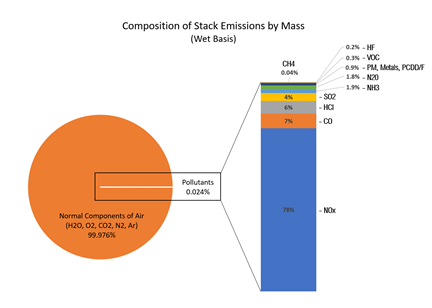
The remaining 0.024% of what is emitted from the stack includes nitrogen oxides (NOx), sulfur dioxide (SO2), carbon monoxide (CO), particulate matter (PM), and volatile organic compounds (VOCs) among several other substances considered pollutants. For these and other constituents, Reworld™ Camden performs much better than federal and regional standards. To learn more about our environmental performance, as well as emissions from other sources within Camden County, check out the full Facility Fact Sheet here.
A combination of continuous emissions monitoring and annual stack testing are important tools used to determine the facility's compliance with the emission limits set forth in its operating permit, which is established in accordance with the Clean Air Act and state regulatory requirements. The facility's operating permit sets the limits on:
- the amount of waste processed,
- the emissions that are allowed, and
- how the air pollution control system is operated.
The stack test sets additional limits on how we operate. Certain operating parameters, like waste throughput and air pollution control operation, become requirements until our next stack test. In addition, there are monitors that operate continuously, 24 hours a day 7 days a week for 365 days a year to check that the combustion units are operating well, and the air pollution control systems are functioning properly. The continuous emissions monitoring equipment at the Camden thermomechanical treatment facility monitors for opacity (a measure of particulate matter) and gaseous compounds such as nitrogen oxides and sulfur dioxides. The facility's operators also continuously measure the amount of steam produced, as well as ensure the consistent high temperature (approximately 2,000 degrees Fahrenheit) required for full combustion is achieved by monitoring and maintaining proper oxygen and carbon monoxide levels. The key to low emissions is good combustion. If carbon monoxide goes up, oxygen levels drop, temperature drops, or steam levels drop - the control room operator knows to adjust fuel rates or the air being fed to the combustion. If the monitor shows alerts for sulfur compounds, nitrogen compounds, or opacity, the facility staff checks and adjusts the air pollution control systems. On rare occasions the facility may have a period of noncompliance related to carbon monoxide (CO). This is usually due to do a disruption in the combustion process, sometimes due to wet waste, and is corrected very quickly. Importantly, this serves as a warning signal for operators to make adjustments to ensure robust combustion.
Monitoring data is shared with the New Jersey Department of Environmental Protection (DEP) and the facility's air permit stipulates compliance periods of 6 minutes, 1 hour, 3 hours, 4 hours and daily averages. Every year there are hundreds of thousands of compliance periods the facility must comply with. If levels go beyond certain limits for a specified duration, they must be reported to the DEP. We encourage anyone interested in the environmental performance of Reworld™ Camden to check out live continuous emissions monitoring systems (CEMS) data, available through the facility webpage.
Research has produced study after study indicating modern thermomechanical treatment facilities employing a Waste-to-Energy process do not pose a significant health risk of any kind for those living in direct proximity. To minimize any environmental impact, Reworld operates the Chester facility up to 99% below its federally regulated standards for emissions. We transparently report on the facility's emissions performance as part of our corporate sustainability reporting.
While further improvements in overall air quality need to be the goal, particularly in communities that have historically borne a disproportionate burden, it is important to note that air quality has been significantly improving in Chester, not getting worse. Overall, according to EPA data found using this tool, concentrations of major pollutants often linked to various health issues have been continuously reduced over time in Delaware County. In 2019, concentrations of nitrogen dioxide (NO2), one of the major compounds included under 'NOx emissions', were on average 59% lower in Delaware County than in nearby Philadelphia. See this fact sheet on local air quality for more.
Concentrations of regulated criteria air pollutants including nitrogen dioxide (NO2), sulfur dioxide (SO2), fine particulate matter (PM2.5), and ozone (O3) have been reduced up to 95% in Delaware County over the last 20 years. Despite being called the 'largest polluter' in the area, the Reworld™ facility in Chester is actually a relatively small source of most pollutants, representing only 11% of total NOx emissions in Delaware County as of 2021. See below for more on how our emissions compare to other sources in the county.
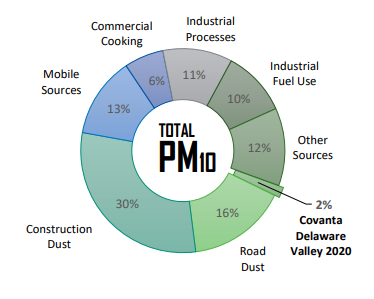
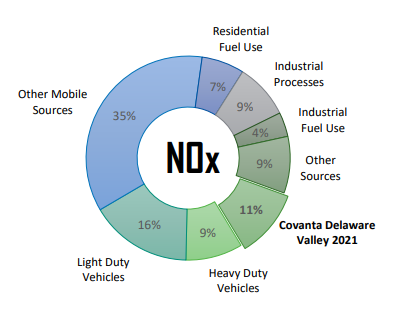
Facilities like Reworld™ Delaware Valley have drawn criticism focusing on a few specific pollutants, namely dioxins and mercury. For dioxins, the facility performs 96% better than permitted levels (or in other words, 96% below permitted levels). According to peer-reviewed scientific research, all of the waste-to-energy facilities in the United States represent less than a tenth of one percent of total sources of dioxin. Dioxin emissions in the U.S. today are predominately from uncontrolled combustion, with fires at landfills representing the largest sources.
According to a recently published study WTE facilities are a minor source of mercury in the U.S. as well, representing just 0.8% of man‐made sources, roughly half that emitted from landfills. U.S. and global scales of comparison are relevant to mercury, as mercury is a global pollutant that can travel thousands of miles before it is deposited and from there potentially enter the food chain. Globally, waste combustion represents just 0.7% of total human-caused mercury emissions.
" target="_blank" rel="noopener">study after study indicating modern thermomechanical treatment facilities employing a Waste-to-Energy process do not pose a significant health risk of any kind for those living in direct proximity. To minimize any environmental impact, Reworld™ operates the Camden facility up to 95% below its federally regulated standards for emissions. We transparently report on the facility's emissions performance as part of our corporate sustainability reporting.While further improvements in overall air quality need to be the goal, particularly in communities that have historically borne a disproportionate burden, it is important to note that air quality has been significantly improving in Camden, not getting worse. Overall, according to EPA data found using this tool, concentrations of major pollutants often linked to various health issues have been continuously reduced over time in Camden County. In 2022, concentrations of nitrogen dioxide (NO2), one of the major compounds included under 'NOx emissions', were actually below the state average in Camden County.
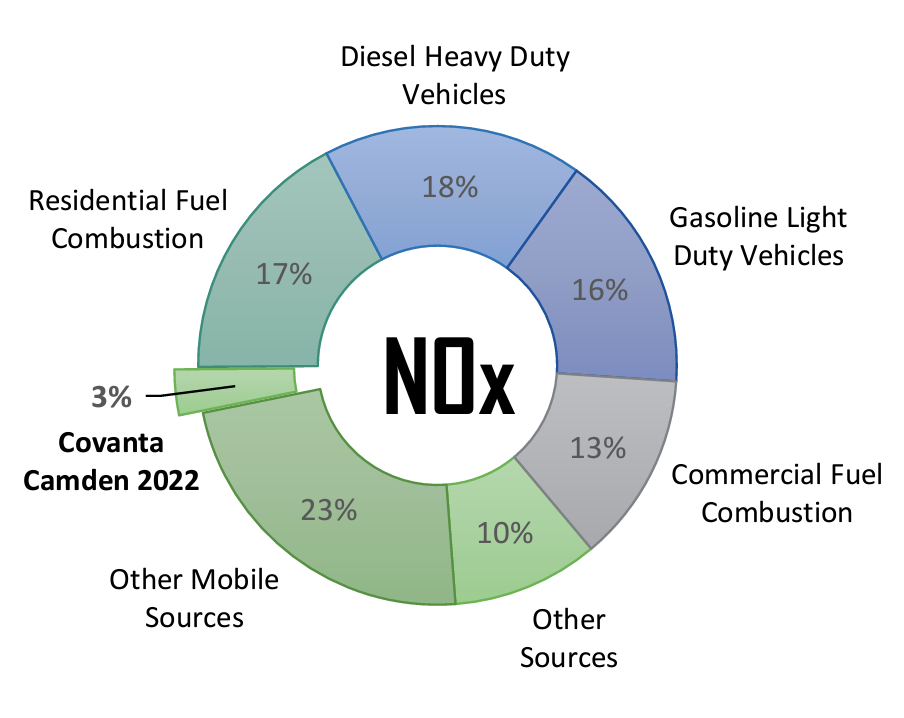
Concentrations of regulated criteria air pollutants including nitrogen oxides (NOx), sulfur dioxide (SO2), fine particulate matter (PM2.5), and ozone (O3) have been reduced up to 97% in Camden County over the last 20 years. Notably, the Reworld facility in Camden is actually a relatively small source of these and other pollutants, representing 3% of total NOx emissions within the county as of 2022. See below for more on how our emissions compare to other sources in the county.
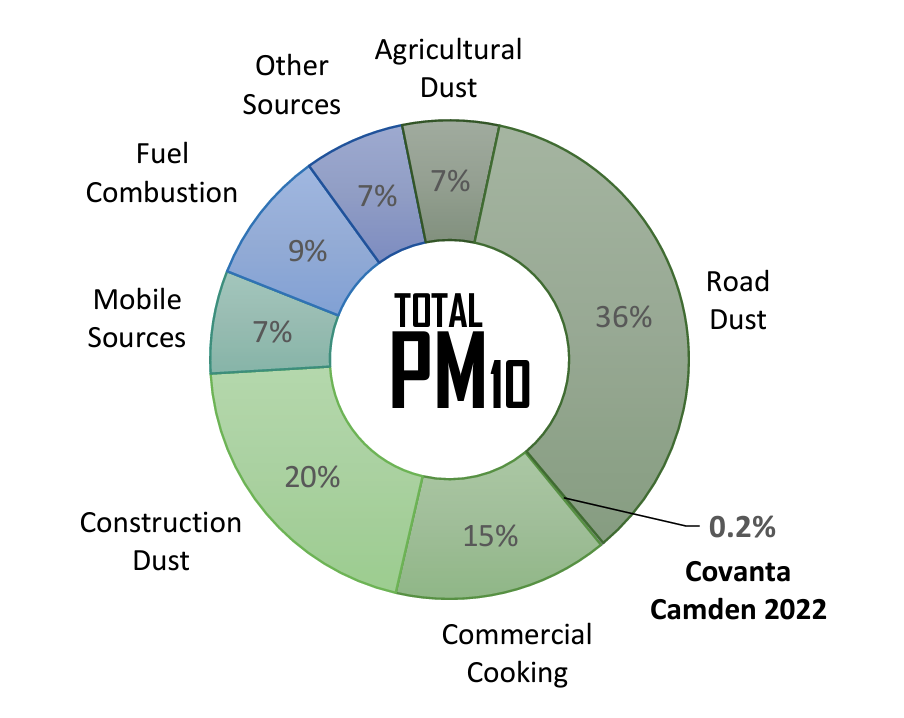
Facilities like Reworld Camden have drawn criticism focusing on a few specific pollutants, namely dioxins and mercury. For dioxins, the facility performs 95% better than permitted levels (or in other words, 95% below permitted levels). According to peer-reviewed scientific research, all of the waste-to-energy facilities in the United States represent less than a tenth of one percent of total sources of dioxin. Dioxin emissions in the U.S. today are predominately from uncontrolled combustion, with fires at landfills representing the largest sources.
According to a recently published study WTE facilities are a minor source of mercury in the U.S. as well, representing just 0.8% of man‐made sources, roughly half that emitted from landfills. U.S. and global scales of comparison are relevant to mercury, as mercury is a global pollutant that can travel thousands of miles before it is deposited and from there potentially enter the food chain. Globally, waste combustion represents just 0.7% of total human-caused mercury emissions.
Years of testing ash from every facility in the country that employs Waste-to-Energy technology, including Reworld Camden, has proven that ash is non-hazardous and safe for reuse. Ash generated from combusting waste is tested routinely for toxicity, using the US EPA's toxicity characteristic leaching procedure (TCLP). In practice, this ash is shown to be more stable and resistant to leaching in a landfill, than normal municipal solid waste (MSW). Residual ash is routinely reused as daily cover at landfills across the country. It exhibits concrete-like properties causing it to harden once it is placed and compacted in a landfill. The ash can also be used in a variety of applications such as roadways and construction as European Union countries have done.
According to both the United States Environmental Protection Agency (EPA) and the European Commission, the most sustainable option for waste management is to prevent waste from being generated, followed by reuse, recycling, and then energy recovery via waste-to-energy at thermomechanical treatment facilities (TTFs). As a result, some of the most sustainable countries in the world rely heavily on TTFs to process their waste. However, most of the waste generated in the US is still disposed of in landfills, even though no state or other jurisdiction defines landfilling as preferred to waste-to-energy through any policy, regulation, or law.
Landfills are unsustainable for several reasons, the most prominent being greenhouse gas emissions. Landfills emit methane, which is a powerful greenhouse gas that directly contributes to climate change. Eliminating one ton of methane emissions is equivalent to eliminating about 84 tons of carbon dioxide emissions. By diverting waste from landfills, thermomechanical treatment significantly reduces methane emissions. Learn more about the benefits of TTFs here.
Reworld fully supports policies to enact better waste reduction, reuse and recycling throughout Camden County. Our thermomechanical facilities are fully compatible with, and in fact complementary to, improved recycling. Many of our communities have a higher recycling rate than the national average — with some reaching over 50%. A growing part of our work is recovering more metals, both ferrous and non-ferrous, from the ash left over following combustion. Currently, Reworld Camden already recycles enough metal every year to build nearly 11,000 cars.
Besides contributing to improved environmental security for future generations, the facility creates over 50 full-time jobs, 13 of which are held by local residents living within 5 miles of the facility. We also continuously provide economic stimulus to Camden through procurement of goods and services.
The facility in Camden also contributes meaningfully via involvement with several local organizations and institutions. In 2017 Reworld Camden was recognized by the Camden Collaborative Initiative for our joint effort with the Go Green Initiative to bring recycling to Camden City Schools. This is just one example of our work to provide social and economic benefit to the community, in addition to inherent environmental benefits provided by our operations. We also provide a significant source of revenue to the City that helps ensure the continuation of essential services. To read more of our work in the community and to see some of the organizations we work with in Camden, check out our Community Blog here.
Since acquiring the Camden facility in 2013, we have invested over $55 million in maintenance and capital expenditures to improve operations and the environmental performance of the facility. A Selective Non-Catalytic Reduction (SNCR) system was also installed at the Camden facility to reduce emissions of nitrous oxides.
Reworld committed to the implementation of five projects across our fleet to further reduce emissions specifically in environmental justice communities. Installing a baghouse at the Camden facility is one of these five projects as part of the Camden Green Initiative. To learn more about this innovative project that will bring great benefits to the city, click here.
The Reworld Camden facility was sited by local government and previous owners decades ago. Facilities like this one were sited due to proximity to industrial centers, which typically translate to large waste generation points, accessibility for waste haulers, availability of water sources for operations, and proximity to a technical workforce.
These facts do not necessarily make the locations of these facilities just, which is why through partnerships with local leaders, Reworld established the Community Outreach and Environmental Justice Policy in 2011. The policy was ground-breaking in its efforts to create a pact with our neighbors in every community where we operate, that we recognize our duty and accountability to perform our operations safely and responsibly. The policy documented our acknowledgement that as a corporate citizen, we have a responsibility to the individuals who live alongside us, to address their concerns and create a dialogue of ongoing understanding and transparency.
Through this environmental justice policy, we have not only formally established our position on the importance of local communities in making decisions that impact their environment but are also thereby committed to reducing emissions from Reworld Camden. In recent times, we have been vehement supporters of the new environmental justice law in New Jersey and pushed for Camden's microgrid project to build the community's resiliency in preparation for future natural disasters. That commitment also requires transparency about our operations, which is why we have worked to make our continuous emissions monitoring data for the Camden facility available for anyone to view 24 hours a day, seven days a week at www.reworldwaste.com/camden. This data is the same information monitored by the New Jersey Department of Environmental Protection (DEP) and required by the facility's air permit to ensure its adherence to the state's stringent environmental regulations. It is also used by operators onsite at the facility to track emissions, anticipate potential issues and resolve them to ensure compliance.
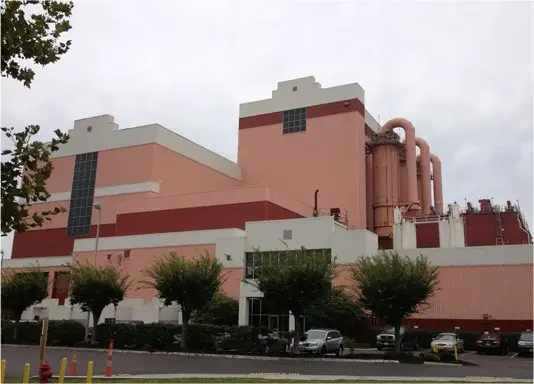
Camden Green Initiative
Our proposed $60 million dollar upgrade to the facility Air Quality Control system, including state-of-the-art fabric filter baghouses, and creation of a Community Benefits Agreement with Camden residents.
Join the team at Reworld Camden
Join our team for a rewarding career partnering with colleagues, customers, and communities to solve one of society's greatest challenges. At Reworld, innovation is encouraged and everyone's ideas are valued.