


Businesses today are under growing pressure to demonstrate measurable progress toward sustainability goals. Investors, customers, regulators, and other stakeholders are asking for commitments and proof, which has pushed organizations to look for practical, verifiable ways to reduce emissions and support cleaner energy systems.
Renewable energy certificates (RECs) have emerged as one of the most widely used tools to do exactly that. They provide a mechanism for tracking renewable energy production, assigning value to its environmental attributes, and enabling businesses to participate in the transition to lower-impact energy without having to build infrastructure themselves.
At the same time, conversations around renewable energy are expanding beyond traditional sources like wind and solar. Waste-to-energy (WTE) is gaining attention as a complementary solution that not only generates energy but also addresses a major environmental challenge: what to do with waste that cannot be recycled.
In this article, we explore how RECs work, why they matter, and how WTE fits into the equation in an effort to help businesses make more informed decisions about their sustainability strategies.
What Are Renewable Energy Certificates?
Renewable energy certificates, sometimes referred to as renewable energy credits, are powerful assets to corporate sustainability initiatives. As businesses strive to meet carbon reduction targets and align with global climate commitments, RECs provide a flexible, verifiable way to demonstrate a business’s use of renewable energy and its dedication to carbon reduction efforts.
But what exactly are RECs, and how do they contribute to emissions reductions and sustainability goals?
RECs are tradable instruments that represent the environmental attributes of one megawatt-hour (MWh) of electricity generated from a renewable source.
Because electricity flows through a shared grid, it is impossible to distinguish whether a specific electron came from a solar farm, a wind turbine, or a natural gas plant. RECs solve this problem by separating the environmental value of renewable generation from the electricity itself.
Each REC certifies that one MWh of renewable electricity was produced and delivered to the grid. When a business purchases a REC, it is claiming the environmental benefits associated with that unit of renewable energy, even if its physical electricity supply comes from a different source. In other words, companies that purchase RECs can credibly claim to be using green energy, regardless of their actual electricity source.
How Do Renewable Energy Certificates Work?
To understand how RECs function, it helps to think of electricity and environmental impact as two separate products.
When a renewable energy facility generates electricity, two things are created: 1) the electricity itself and 2) an REC representing the environmental attributes of that electricity. As Michael Van Brunt, Vice President of Environmental and Sustainability at Reworld®, explains, “When we put a megawatt hour of electricity onto the grid, we’re generating a megawatt hour of commodity electricity as well as one REC.” These two components can be sold together or separately.
This separation allows for greater flexibility in the market. A company can purchase RECs to match its electricity consumption without needing a direct physical connection to a renewable energy source. In doing so, the company is not changing the physical electricity delivered to its facility, but it is applying the environmental attributes of renewable generation to the electricity it uses. This process is especially relevant for Scope 2 emissions, which include indirect emissions from purchased electricity, steam, heating, and cooling.
For renewable energy producers, RECs also create a way to monetize the environmental value of their generation, providing additional financial incentives to expand clean energy capacity.
The Connection Between RECs and Scope 2 Emissions
Greenhouse gas emissions are typically categorized into three scopes:
- Scope 1: Direct emissions from owned or controlled sources
- Scope 2: Indirect emissions from purchased electricity, steam, heating, and cooling
- Scope 3: All other indirect emissions across the value chain
RECs play a direct role in Scope 2 emissions reporting. Under the market-based method, a company can use RECs to match its electricity consumption with renewable generation, which allows the organization to report lower Scope 2 emissions by demonstrating that the environmental attributes of renewable energy have been applied to its energy use. It’s one of the primary reasons RECs have become so widely adopted in corporate sustainability strategies.
Who Issues Renewable Energy Certificates?
RECs are issued and tracked through regional and national certification systems that verify renewable energy generation. In the United States, these systems are typically managed by independent organizations that operate electronic tracking platforms.
These registries confirm that:
- The energy was generated from an eligible renewable source
- The amount of electricity produced is accurately measured
- Each REC is uniquely tracked to prevent double counting
Once issued, RECs can be bought, sold, or retired. Retirement is the final step, where a business claims the environmental benefit and removes the REC from circulation.
State-level programs also play a significant role. Many states have renewable portfolio standards (RPSs), which require utilities to source a percentage of their electricity from renewable resources. RECs are commonly used to meet these requirements.

6 Benefits of Renewable Energy Certificates
RECs offer a range of strategic advantages for businesses looking to advance sustainability initiatives. Beyond simply “checking a box,” they provide a structured, verifiable way to participate in renewable energy markets, align with emissions reporting frameworks, and influence how electricity is generated at scale.
For organizations that cannot immediately transition their physical energy supply, RECs create a practical pathway to act now while building toward longer-term energy strategies.
1. Environmental Impact
By purchasing RECs, companies help increase demand for renewable energy generation, which in turn supports the expansion of lower-impact energy sources. While RECs do not physically change the electricity flowing to a facility, they shift market incentives by directing revenue toward renewable producers. Over time, this practice contributes to a broader transition away from fossil fuel-based generation and toward a cleaner grid mix.
2. Measurable and Reportable Progress
RECs provide a standardized, auditable mechanism for documenting renewable energy use. This piece is critical for sustainability reporting, especially under frameworks such as the Greenhouse Gas Protocol, CDP, and Science-Based Targets. Because each REC is tracked and retired in a registry, organizations can demonstrate clear, verifiable claims about their renewable energy consumption rather than relying on estimates or assumptions.
3. Financial and Operational Flexibility
Developing on-site renewable energy or entering into long-term power purchase agreements can require significant capital, time, and operational complexity. RECs offer a more accessible alternative. Companies can scale purchases up or down based on changing energy use, budget constraints, or evolving sustainability targets, making RECs a highly adaptable tool within a broader energy strategy.
4. Regulatory and Compliance Support
In regions with renewable portfolio standards or other clean energy mandates, RECs play a central role in compliance. Utilities and, in some cases, businesses use RECs to meet required renewable energy thresholds. Even in voluntary markets, RECs can help organizations stay ahead of regulatory trends and prepare for future requirements related to emissions disclosure and clean energy sourcing.
5. Market Signaling and Investment Impact
RECs send a clear signal to the energy market. When businesses consistently purchase RECs, they help create stable demand for renewable energy attributes. This demand supports project financing, encourages new development, and strengthens the economic case for expanding renewable generation capacity.
6. Bridge to Longer-Term Energy Strategies
For many organizations, RECs serve as an interim step while more complex solutions are developed. They allow companies to begin addressing Scope 2 emissions immediately while evaluating options such as on-site generation, energy procurement strategies, or partnerships with providers like Reworld®. This bridge function is often what makes RECs so valuable in real-world sustainability roadmaps.
Why Businesses Value RECs
For many organizations, RECs are not just a compliance tool but also a practical way to manage risk, meet stakeholder expectations, and make credible progress while longer-term energy strategies are still being developed. In a time where sustainability claims are increasingly scrutinized, RECs provide a defensible, standardized way to show action backed by verifiable data.
Companies use RECs in several ways:
- To support carbon reduction targets: RECs allow companies to address Scope 2 emissions under the market-based method by matching electricity consumption with renewable generation. This method is often one of the fastest ways to show progress against internal targets and external commitments.
- To demonstrate environmental leadership to stakeholders: Customers, investors, and partners are looking for tangible proof of sustainability efforts. REC purchases provide a clear, third-party verifiable signal that a company is actively supporting renewable energy markets, not just setting goals.
- To strengthen ESG reporting and disclosures: With increasing pressure from frameworks like CDP, TCFD, and the Greenhouse Gas Protocol, companies need auditable data. RECs, tracked and retired through registries, provide documentation that stands up to reporting and assurance requirements.
- To align with frameworks like Science-Based Targets: Many organizations use RECs as part of a broader decarbonization pathway, particularly in the near term, while they evaluate deeper operational changes such as electrification or direct renewable procurement.
- To manage cost and timing constraints: Large-scale energy transitions take time and capital. RECs allow companies to act immediately without waiting for infrastructure projects, contract negotiations, or site-level changes to be completed.
They also provide a bridge. While companies work toward longer-term solutions such as on-site generation or power purchase agreements, RECs offer an immediate way to take action and maintain momentum toward sustainability goals.

How Much Do Renewable Energy Certificates Cost?
REC pricing can vary widely depending on several factors, including the following:
- Geographic location and grid region (e.g., PJM, CAISO, ERCOT)
- Supply and demand within a specific market
- Type of renewable energy source (solar, wind, hydro, biomass, waste-to-energy, etc.)
- Whether the REC is voluntary or compliance-based (RPS-driven)
- Vintage (the year the energy was generated)
- Certification and eligibility class (state-specific tiers or carve-outs like solar RECs)
- Project age and technology (new build vs. existing generation)
- Policy and regulatory changes affecting supply or mandates
- Contract structure (spot purchases vs. long-term agreements)
- Bundled vs. unbundled RECs (with or without associated electricity)
- Co-benefits or attributes (e.g., local sourcing, emissions profile)
- Time-matching requirements (annual vs. hourly matching)
In voluntary markets, prices are often relatively low, sometimes just a few dollars per MWh. In compliance markets tied to state renewable portfolio standards, prices can be significantly higher due to regulatory demand.
This variability makes RECs a flexible option for businesses. Organizations can scale their purchases based on budget, sustainability targets, and geographic priorities.
How Can Businesses Generate RECs?
While many companies purchase RECs, others generate them by producing renewable energy themselves.
Various technologies enable businesses to contribute to the green energy market while benefiting from additional revenue streams associated with REC scales. Common methods include solar power, wind energy, hydropower, and biomass. However, some of the most promising and innovative approaches rely on recovering energy from waste.
“Renewable energy recovery” is a term that encompasses several advanced methods of processing waste materials into electricity, steam, and/or heat, all of which address critical waste management and carbon reduction challenges while providing power sources that continually replenish. Businesses operating in industries that generate large amounts of waste especially benefit from renewable energy recovery for obvious reasons but also because they can leverage the various recovery technologies to avoid the risks of landfill disposal, convert otherwise unsalvageable materials into energy, and contribute to REC generation—helping them support greater sustainability goals without having to invest in in-house infrastructure or resources that they weren’t already being produced.
Common Types of Renewable Energy Recovery
Renewable energy recovery is not a single process. It is a category of technologies designed to extract usable energy from materials like waste, industrial byproducts, and/or organic materials that would otherwise be discarded.
Each approach differs in how it processes waste, what types of materials it can handle, and the form of energy it produces. These technologies play a role in reducing reliance on landfills and extracting value from waste streams. In many cases, they are complementary rather than competitive, forming part of a broader system that prioritizes reduction, recycling, and then energy recovery for what remains.
Some of the most widely used methods include the following.
Waste-to-Energy
Though their names differ from region to region, WTE, energy-from-waste (EFW), incineration, and so on all refer to the same technology.
Waste-to-energy is the most established and widely deployed form of energy recovery for mixed, non-recyclable waste. The process uses controlled combustion at high temperatures to generate steam, which is then used to produce electricity or provide thermal energy. It’s particularly effective for handling heterogeneous waste streams that cannot be easily sorted or recycled, making it a critical component of reducing landfill dependency.
While many businesses and communities are aware of WTE’s ability to drastically reduce landfill dependencies, far fewer are aware of its ability to reduce greenhouse gas emissions and stimulate recycling.
In the United States, most modern sites for waste-to-energy processing are known as thermomechanical treatment facilities (TTFs). In addition to having WTE capabilities, TTFs are also equipped with advanced systems that filter and control emissions, extract metals for recycling, reuse water, and perform several other functions that contribute to minimizing environmental impacts while maximizing value creation.
Anaerobic Digestion
Anaerobic digestion (AD) is a biological process that breaks down organic materials such as food waste, agricultural waste, and wastewater sludge in an oxygen-free environment. Microorganisms convert these materials into biogas, which can be used to generate electricity, heat, or renewable natural gas.
AD works best with source-separated organic waste, where contamination is minimal. When properly managed, it produces both energy and a byproduct known as digestate, which can be used as a soil amendment. However, its effectiveness depends heavily on feedstock quality and consistency.
Gasification and Pyrolysis
Gasification and pyrolysis are thermal processes that convert waste into synthetic gas, oils, or other fuels under controlled conditions with limited or no oxygen. These technologies operate differently from traditional combustion and are often positioned as advanced or emerging solutions.
In practice, their performance is highly dependent on the consistency of the input material. Mixed waste streams can create challenges, as variability in composition can impact process stability and output quality. As a result, these technologies are often better suited to more uniform feedstocks rather than highly heterogeneous municipal solid waste.
Capitalizing on RECs Through Waste-to-Energy
Waste-to-energy offers a unique advantage in the REC landscape. Unlike some renewable sources that depend on weather conditions, WTE facilities can provide a consistent energy output. This stability supports ongoing REC generation and helps maintain a steady contribution to renewable energy supply.
At the same time, waste-to-energy addresses a critical environmental issue: “Every single piece of waste that you generate, regardless of whether you recycle it or send it somewhere else, has an impact,” Van Brunt notes. “With WTE, our job is to figure out how we can lessen that impact to the extent that we possibly can.”
By diverting waste from landfills, WTE reduces methane emissions, which are significantly more potent than carbon dioxide in the near term. It also recovers metals for recycling and displaces fossil fuel-based electricity generation.
These combined benefits make waste-to-energy a compelling component of a broader sustainability strategy.
RECs and Waste-to-Energy in a Business Sustainability Strategy
For businesses, the opportunity is not just about purchasing RECs or managing waste but also about integrating both into a cohesive strategy. A strong approach might include:
- Using RECs to address Scope 2 emissions
- Partnering with waste-to-energy providers to divert non-recyclable waste
- Reducing landfill dependency
- Supporting circular economy initiatives
Here is where Reworld® plays a critical role.
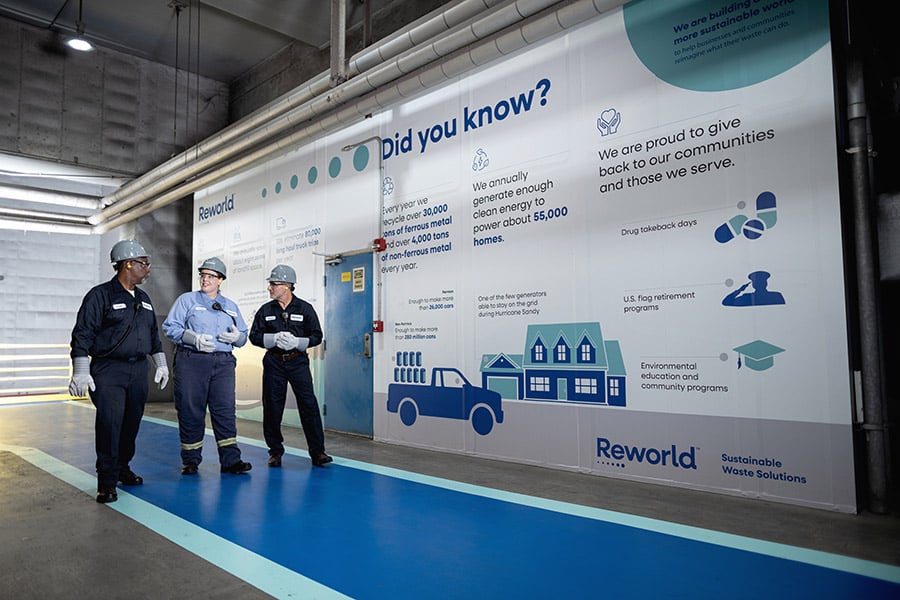
At Reworld®, we help organizations manage waste more sustainably while generating energy and supporting renewable energy goals. Through our renewable energy recovery solutions, businesses can reduce environmental impact, move closer to net zero and zero waste-to-landfill targets, and align operational practices with broader sustainability commitments.
Renewable Energy Certificates: FAQs
Are RECs the Same as Carbon Offsets?
No. RECs represent renewable energy generation, while carbon offsets represent reductions or removals of greenhouse gas emissions from projects such as reforestation or carbon capture. The two serve different purposes within a sustainability strategy. RECs are primarily used to address Scope 2 emissions, while offsets are often used for Scope 1 or Scope 3 emissions that cannot yet be reduced directly. Many organizations use both, but they are not interchangeable.
Do RECs Physically Change the Electricity a Business Uses?
No. Electricity is delivered through a shared grid, meaning all generated power is mixed together before reaching end users. RECs do not alter the physical electrons flowing to a facility. Instead, they provide a credible accounting mechanism that allows businesses to claim the environmental attributes of renewable energy generation. This distinction is important for understanding how RECs fit into emissions reporting frameworks.
Does Waste-to-Energy Generate RECs?
In certain markets and regulatory frameworks, waste-to-energy facilities can qualify for REC generation. Eligibility depends on state-level policies, renewable portfolio standards, and how the energy source is classified. In some regions, waste-to-energy is recognized for its ability to recover energy from non-recyclable materials and reduce landfill impacts. Businesses should evaluate local regulations to understand how RECs from waste-to-energy may apply to their strategy.
Are RECs Enough to Achieve Sustainability Goals?
RECs are a valuable tool, but they are not a complete solution on their own. Most organizations combine RECs with other initiatives such as energy efficiency improvements, operational changes, and waste reduction efforts. A well-rounded sustainability strategy typically includes both immediate actions like REC purchases and longer-term investments in infrastructure or process changes. This layered approach helps create more durable and credible progress over time.
What Is the Difference Between Voluntary and Compliance RECs?
Voluntary RECs are purchased by organizations that choose to support renewable energy beyond regulatory requirements. Compliance RECs are used by utilities or entities that must meet state-mandated renewable portfolio standards. The two markets operate differently, with compliance RECs often carrying higher prices due to regulatory demand.
How Do Companies Retire RECs and Claim the Benefit?
RECs must be retired in an official registry before a company can claim the associated environmental benefits. Retirement removes the REC from circulation, preventing it from being sold or claimed by another party. This process is what makes REC-based claims credible and auditable. Without retirement, a REC cannot be used to support emissions reporting or renewable energy claims.
Why Is Waste-to-Energy Considered Part of a Circular Approach?
Waste-to-energy plays a role in the circular economy by recovering value from materials that cannot be recycled. Instead of sending residual waste to landfills, it converts that material into usable energy while also recovering metals for recycling. This process reduces reliance on landfill disposal and supports more efficient resource use. It complements recycling and reduction efforts rather than replacing them. What’s more is the energy generated from WTE processes can also be used to power other systems, businesses, or communities, creating a closed-loop framework in which final outputs (waste) are reintroduced to the cycle and used as inputs (electricity).

Contact Reworld® Today for Waste-to-Energy Solutions
Renewable energy certificates have become a foundational tool for organizations working to reduce emissions and support cleaner energy systems. They offer flexibility, accountability, and a clear pathway for participation in renewable energy markets. At the same time, waste-to-energy provides a practical solution for one of the most persistent environmental challenges: managing residual waste while recovering value from it.
Together, these approaches give businesses a way to move beyond incremental change and toward more integrated sustainability strategies.
Want to learn how your organization can align renewable energy goals with smarter waste management? We can help. Contact us today to get a quote and explore our renewable energy recovery solutions.